Your Name: _______________________ PHY203
Final
Exam
12/18/09
Lecture
Time: 9
a.m 1p.m. 2p.m. 3p.m. Honors
Part 1
1-10 ________ (out of 60)
11 ________ (out of 40)
Total
_______
Multiple
choice answer sheet-shade in correct answers below
(one choice per problem):
|
|
1 |
2 |
3 |
4 |
5 |
6 |
7 |
8 |
9 |
10 |
|
a |
|
|
|
|
|
|
|
|
|
|
|
b |
|
|
|
|
|
|
|
|
|
|
|
c |
|
|
|
|
|
|
|
|
|
|
|
d |
|
|
|
|
|
|
|
|
|
|
|
e |
|
|
|
|
|
|
|
|
|
|
PHY203
Crib
Sheet
Chapters
1-3
speedAV = (total distance traveled)/Dt
Dx
= x2 – x1 (displacement)
vAV = Dx/Dt
aAV = Dv/Dt
vInst = dx/dt
aInst = dv/dt
For constant acceleration:
xf = xo + vot
+ (1/2)at2
vf = vo + at
Vf2 = vo2 +
2a(xf - xo)
g = 9.81 m/s2, the
acceleration due to gravity (on Earth), unless otherwise directed
For a vector A
with magnitude A and direction q (measured counterclockwise with respect to the
x-axis):
Ax = Acos(q)
Ay = Asin(q)
A = (Ax2 + Ay2)1/2
tan(q) = Ay/Ax
quadratic eq. sol.: If ax2 + bx + c = 0; then x =[ -b+(b2-4ac)1/2]/(2a)
For problems 1-4, consider a rocket being
launched from rest straight up into the atmosphere of Planet XXX where the
acceleration due to gravity is exactly 10m/s2. In the first stage,
the rocket accelerates at 20m/s2 for 15s. Then the motor cuts off and the rocket continues to travel
upwards for a while.
1. Find the height of the rocket when the motor cuts off.
a. 75
m
b. 150
m
c. 1125
m
d. 2250
m
e. 4500
m
2. Find the speed of the rocket when the motor cuts off.
a. 150
m/s
b. 300
m/s
c. 2250
m/s
d. 4500
m/s
e. None
of the above
3. Find the height of the rocket at which it stops traveling upwards and begins to descend.
a. 1125
m
b. 2250
m
c. 3375
m
d. 4500
m
e. 6750
m
4. Find the total time the rocket is in the air before it hits the ground.
a. 8.8
sec.
b. 23.8
sec.
c. 66.2
sec.
d. 81.7
sec.
e. 148.5
sec.
For problems 5 and 6, on Planet XXX where the acceleration due to
gravity is exactly 10m/s2, consider 2 balls that are dropped or
thrown from a cliff. In both cases, find the time, t, at which the rocks are
side-by-side.
5. Case 1: rock a is
dropped from the cliff at t=0 sec.; rock b is dropped from the cliff at t=5
sec.
a. 2.5
sec.
b. 5.0
sec.
c. 7.5
sec.
d. 10.0
sec.
e. None
of the above
6. Case 2: rock a is
dropped from the cliff at t=0 sec.; rock b is thrown straight down at t=2 sec.
with an initial speed of 40 m/s.
a. 2.0
sec.
b. 3.0
sec.
c. 4.0 sec.
d. 5.0 sec.
e. 6.0 sec.
7. Let B
= 3i - 4j. Find the magnitude of
the vector B and the angle that vector B makes with the positive x-axis (measured in a counterclockwise direction from
the positive x-axis):
a. 1,
307o
b. 1, 323o
c. 5,
307o
d. 5,
323o
e. None
of the above
Problems
8-10
The
figure below shows nine graphs of position, velocity, and acceleration for
objects in linear motion.
Choose
the letter in each case below that has all the graphs that clearly meet
the following conditions:
8. Velocity is constant
a. a,f
b. a,f,h
c. a,f,i
d. a,d,e,f
e. a,f,h,i
9. Velocity has reversed its direction
a. c,d
b. c,i
c. b,c,d
d. c,d,i
e. b,c,d,g
10. Acceleration is constant
a. h,i
b. a,f,h,i
c. d,ef,h,i
d. a,d,e,f,i
e. a,d,e,f,h,i
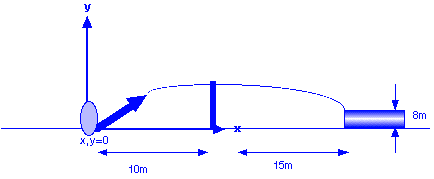
11. A football is kicked from 10m from a
goalpost such that it "just clears" the goalpost (i.e. is at its
highest point as it clears the goalpost) and then lands in the 3rd row of the
stands (at a height of 8m) 5.0 m
behind the goalpost. The total time the ball is in the air is 1.5s. (Use
g=9.81m/s2)
a.
Calculate the x-component of the initial velocity.
b.
Calculate the y-component of the initial velocity.
c. Write the initial velocity vector, vo,
as a vector in proper vector notation, using
the coordinate system given above.
d.
Calculate the height of the goalpost.
e.
Calculate the final velocity in the x-direction of the projectile just
before it hits
the stands and express it as a vector in proper
vector notation, using the
coordinate
system given above.
f.
Calculate the final velocity in the y-direction of the projectile just
before it hits
the stands coordinate
system given above using the coordinate system given
above.