Your Name: _______________________ PHY203
Exam
#3
Chapters
8-10
Fri.,
4/16/10
Lecture
Time: 1p.m. 2p.m.
1-10 _________________ (out
of 60)
11 _________________ (out
of 40)
Score _______________
Multiple
choice answer sheet-shade in correct answers below
(one
choice per problem):
|
|
1 |
2 |
3 |
4 |
5 |
6 |
7 |
8 |
9 |
10 |
|
a |
|
|
|
|
|
|
|
|
|
|
|
b |
|
|
|
|
|
|
|
|
|
|
|
c |
|
|
|
|
|
|
|
|
|
|
|
d |
|
|
|
|
|
|
|
|
|
|
|
e |
|
|
|
|
|
|
|
|
|
|
Exam #3
Crib
Sheet
Chapters
8-10
center of mass: Mtotrcm = m1r1 + m2r2+ m3r3 + ....
velocity of center of mass: Mtotvcm = m1v1 + m2v2+ m3v3 + ....
Fnet ext = Macm
momentum: p = mv
Conservation
of momentum (net external force = 0): pinitial = pfinal
Kinetic
energy, K = (1/2)mv2 K =
(1/2)Iw2 for rotating objects
K = (1/2)m vcm 2 + (1/2)Iw2 for objects rolling w.o slipping
For objects rolling w.o slipping, : vcm
= wr (cm =
center-of-mass)
Gravitational Potential Energy, U = mgh
Impulse:
I = Dp = FavDt
For
a vectors A,B,C with magnitude A,B,C
and direction:
If
C = A x B; C = ABsinq with direction of C given
by the right hand rule
i x j = k; j x k = i; k x i = j
moment
of inertia: I
= mr2 for a single particle
torque:
t = r x F
= Ia
angular
momentum: L
= r x p or L
= Iw where p = mv
parallel axis theorem: I = ICM + Mh2
For constant angular acceleration:
q = qo + wot
+ 1/2at2
w = wo + at
w2
= (wo )2 + 2a(Dq)
For rotating objects: vtan = wr
circumference
of a circle = 2pr
1.
Let the vector A = – 4j and B = 3j. Find the vector A x B:
a. 0
b. -12i
c. +12i
d. -12k
e. +12k
2.
Let the vector A = – 4j and B = 3i. Find the vector A x B:
a. 0
b. -12i
c. +12i
d. -12k
e. +12k
3.
Let the vector A = 5i – 4j and B = -3i + 2k. Find the vector A x B:
a. -8i -10j - 12k
b. -8i -10j + 12k
c. -8i +10j - 12k
d. -8i +10j + 12k
e. +8i +10j + 12k
4. A hoop is lying on a horizontal table while it is spinning. Looking down on the table from above, the hoop is spinning in a counterclockwise direction. Find the direction of the angular momentum vector:
a. Out of the table (towards the observer)
b. Into the table (away from the observer)
c. Neither a. nor b.
d. Not enough information is given.
5.
Find the kinetic energy of a solid cylinder with mass=3kg and radius=2m
which is rolling without slipping with a center-of-mass velocity of 4 m/s:
a. 6 J
b. 12 J
c. 24 J
d. 36 J
e. 48 J
For problems 6 and 7,
6. A
hoop of mass 4kg and radius 1.0m is rotating with an angular speed of 3rad/s. A
blob of clay of mass 0.5kg is dropped onto the rim of the hoop from above and
sticks to the hoop. Find the magnitude of the angular momentum of the
hoop-putty system before the putty has stuck to the hoop:
a. 33.0 kgm2/s
b. 4.0 kgm2/s
c. 6.0 kgm2/s
d. 12.0 kgm2/s
e. 48.0 kgm2/s
7. Find the magnitude of the angular velocity
of the hoop-putty system after the putty has stuck to the hoop:
a. 0.89
rad/s
b. 2.67
rad/s
c. 3.0 rad/s
d. 3.43
rad/s
e. 10.7
rad/s
For problems 8-10,
Point masses are placed as follows along the
x-axis: 1kg at x=0, 2kg at x=1m, and 3kg at x=2m, all connected by a massless
rod.
8.
Find the x position of the center of mass:
a. 0
b. 1.33m
c. 1.5m
d. 1.6m
e. 2.33m
9.
Find the moment of inertia about the x-axis:
a. 0 kgm2
b. 8.0 kgm2
c. 9.0 kgm2
d. 14.0 kgm2
e. 15.0 kgm2
10.
Find the moment of inertia about the y-axis:
a. 0 kgm2
b. 8.0 kgm2
c. 9.0 kgm2
d. 14.0 kgm2
e. 15.0 kgm2
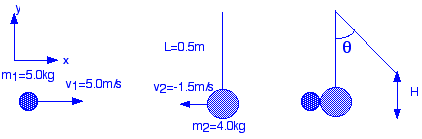 11. A
4.0kg pendulum bob at the end of a string of length L=0.5m is released from
some angle such that just as it reaches the bottom of its trajectory it has a
speed of 1.5m/s. At this point, the 4.0 kg bob collides with a ball of mass 5.0kg
and speed 5.0m/s, as shown above. The two balls stick together and swing up to
the right. Use g=9.81m/s2.
11. A
4.0kg pendulum bob at the end of a string of length L=0.5m is released from
some angle such that just as it reaches the bottom of its trajectory it has a
speed of 1.5m/s. At this point, the 4.0 kg bob collides with a ball of mass 5.0kg
and speed 5.0m/s, as shown above. The two balls stick together and swing up to
the right. Use g=9.81m/s2.
a.
Calculate the initial linear momentum of the two ball system just before
the collision and express it in vector notation using the coordinate
system above.
b.
Calculate the initial kinetic energy of the two-ball system just before
the collision.
c.
Calculate the linear momentum of the two-ball system just after the
collision before the balls start to swing up and express it in vector
notation using the coordinate system above.
d.
Calculate the velocity of the two-ball system just after the collision
before the balls start to swing up and express it in vector notation
using the coordinate system above.
e.
Calculate the kinetic energy of the two-ball system just after the
collision before the balls start to swing up.
f. Is the
collision elastic or inelastic or can you not tell?
g.
Calculate the height, H, of the two-ball system when it stops
(momentarily) at the highest point.
h. Find
the angle, q, the string makes with the vertical at that height,
H.