Your Name: _______________________ PHY203
Exam
#1
Chapters
1-3
Fri.,
2/19/10
Lecture
Time: 1p.m.
1-10 _________________ (out
of 60)
11 _________________ (out
of 40)
Total _______________
Multiple
choice answer sheet-shade in correct answers below
(one
choice per problem):
|
|
1 |
2 |
3 |
4 |
5 |
6 |
7 |
8 |
9 |
10 |
|
a |
|
|
|
|
|
|
|
|
|
|
|
b |
|
|
|
|
|
|
|
|
|
|
|
c |
|
|
|
|
|
|
|
|
|
|
|
d |
|
|
|
|
|
|
|
|
|
|
|
e |
|
|
|
|
|
|
|
|
|
|
PHY203
Exam
#1
Crib
Sheet
Chapters
1-3
speedAV = (total distance traveled)/Dt
Dr
= r2 – r1 (displacement)
vAV = Dr/Dt
aAV = Dv/Dt
vInst = dr/dt
aInst = dv/dt
For constant acceleration:
xf = xo + vot
+ (1/2)at2
vf = vo + at
Vf2 = vo2 +
2a(xf - xo)
use g = 9.81 m/s2,
the acceleration due to gravity, unless otherwise directed
For a vector A
with magnitude A and direction q (measured counterclockwise with respect to the
x-axis):
Ax = Acos(q)
Ay = Asin(q)
A = (Ax2 + Ay2)1/2
tan(q) = Ay/Ax
quadratic eq. sol.: If ax2 + bx + c = 0; then x = -b+(b2-4ac)1/2/(2a)
1. The speed of sound
in air is 343m/s. Find the speed in miles per hour of a supersonic plane flying
at 10 times the speed of sound.
a. 0.59
mph
b. 128
mph
c. 331 mph
d. 7670
mph
e. 19,900 mph.
For problems 2 and 3, an object is moving along the x axis. At t=6.0
s, the object is at x=4.0m and its velocity is +4.5m/s. At t=10s, the object is
at 11.0m and its velocity is -1.5m/s.
2. Find the average
velocity of the object during the time interval 6-10 s.
a. 0.45
m/s
b. 0.75
m/s
c. 1.5 m/s
d. 1.75
m/s
e. 3.75 m/s.
3. Find the average
acceleration of the object during the time interval 6-10 s.
a. -1.5
m/s2
b. -0.75
m/s2
c. 0.75 m/s2
d. 1.5 m/s2
e. None
of the above
4. Determine the x and
y components of a 30m/s velocity vector which makes an angle of 300
counterclockwise from the positive x axis.
a. vx=
15m/s, vy= -26m/s
b. vx=
26m/s, vy= -15m/s
c. vx=
+15m/s, vy= +26m/s
d. vx=
26m/s, vy= +15m/s
e. None
of the above
5. Determine the x and
y components of a 30m/s velocity vector which makes an angle of 600
clockwise from the negative x axis.
a. vx=
-26m/s, vy= -15m/s
b. vx=
-26m/s, vy= +15m/s
c. vx=
+15m/s, vy= -26m/s
d. vx=
-15m/s, vy= +26m/s
e. vx=
+26m/s, vy= -15m/s
6. Let A = -4i + 6j, B = 3i - 10j, C = -3A + 3B
Write the vector, C, in vector notation:
a. -3i - 48j
b. -3i
- -12j
c. 21i - 48j
d. 21i - 12j
e. None
of the above
For problems 7-10, on Planet XXX, the acceleration due to gravity is
exactly 10m/s2. Rocks are dropped from the top of a cliff at a
height of 500m.
7. Case1: a rock of mass 1.5kg is dropped. Find the time, t, at
which the rock hits the bottom of the cliff.
a. 5.0
sec.
b. 7.1
sec.
c. 10.0
sec.
d. 100
sec.
e. None
of the above
8. Case 2: a rock of
mass 3.0kg is dropped from the top of the same cliff as above. Find the time,
t, at which the rock hits the bottom of the cliff.
a. 5.0
sec.
b. 7.1
sec.
c. 10.0
sec.
d. 100
sec.
e. None
of the above
9. Case 3: the 1.5kg
rock is thrown straight down with an initial speed of 40 m/s. Find the time, t,
at which the rock hits the bottom of the cliff.
a. 0.45
sec.
b. 6.8
sec.
c. 13.5 sec.
d. 14.8 sec.
e. 29.5 sec.
10. Case 4: identical
rocks of mass 1.5kg: rock a is dropped from the cliff at t=0 sec.; rock b is
thrown straight down at t=2 sec. with an initial speed of 40 m/s. Find the
time, t, at which the rocks are side-by-side.
a. 1.0
sec.
b. 2.0
sec.
c. 3.0
sec.
d. 4.0 sec.
e. 5.0 sec.
11. A missile is shot
from a cliff with height H = 400m and initial speed of 50m/s and an angle q = 55o,as shown below. Use g =9.81 m/s2. Show
your work.
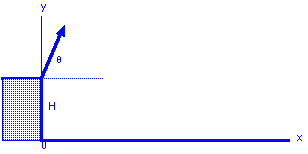
a.
Write the initial velocity vector, vi, in vector notation, using the coordinate
system above.
b.
Calculate the time in sec. that it will take for the missile to reach
its highest point.
c.
Calculate the time in sec. that it will take for the missile to hit the
ground.
d.
Calculate the x position at which the missile will hit the ground.
e.
Write the final velocity vector (just as striking the ground), vi,
in vector
notation, using the coordinate system above.