Your Name: _______________________ PHY203
Exam
#1
Chapters
1-3
Fri.,
2/06/09
Lecture
Time: 1p.m. 2p.m.
1-10 _________________ (out
of 60)
11 _________________ (out
of 40)
Total _______________
Multiple
choice answer sheet-shade in correct answers below
(one
choice per problem):
|
|
1 |
2 |
3 |
4 |
5 |
6 |
7 |
8 |
9 |
10 |
|
a |
|
|
|
|
|
|
|
|
|
|
|
b |
|
|
|
|
|
|
|
|
|
|
|
c |
|
|
|
|
|
|
|
|
|
|
|
d |
|
|
|
|
|
|
|
|
|
|
|
e |
|
|
|
|
|
|
|
|
|
|
PHY203
Exam
#1
Crib
Sheet
Chapters
1-3
speedAV = (total distance traveled)/Dt
Dr
= r2 – r1 (displacement)
vAV = Dr/Dt
aAV = Dv/Dt
vInst = dr/dt
aInst = dv/dt
For constant acceleration:
xf = xo + vot
+ (1/2)at2
vf = vo + at
Vf2 = vo2 +
2a(xf - xo)
use g = 9.81 m/s2,
the acceleration due to gravity, unless otherwise directed
For a vector A
with magnitude A and direction q (measured counterclockwise with respect to the
x-axis):
Ax = Acos(q)
Ay = Asin(q)
A = (Ax2 + Ay2)1/2
tan(q) = Ay/Ax
quadratic eq. sol.: If ax2 + bx + c = 0; then x = -b+(b2-4ac)1/2/(2a)
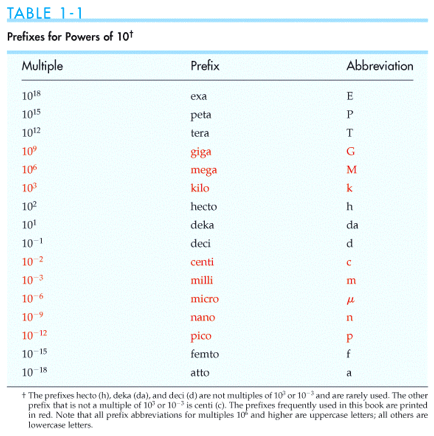
1. How many cubic centimeters is a volume of 3
quarts?
a. 5.05x10⁻³
cm3
b. 1.98x10²
cm3
c. 2.84x10³
cm3
d. 5.05x10³
cm3
e. None
of the above
For problems 2-5 consider two trains approaching each other from
opposite directions on parallel tracks. The measurements start when they are
200m apart. In all cases below, train 1 is traveling to the right and passes
the position x=0 at t=0 traveling in the positive x-direction towards train 2
at a constant speed of 5 m/s. In all cases below, find the x position at which
the trains just start to pass each other:
2.
Case 1: Train 2 passes the x=200m position at t=0 traveling with a constant
speed of 5 m/s.
a. 50m
b. 125m
c. 150m
d. 175m
e. None
of the above
3.
Case 2: Train 2 passes the x=200m position at t=0 traveling with a constant
speed of 4 m/s.
a. 22.2m
b. 88.9m
c. 111m
d. 200m
e. None
of the above
4.
Case 3: Train 2 passes the x=200m position at t=10s traveling with a constant
speed of 4 m/s.
a. 26.6m
b. 71.1m
c. 88.8m
d. 133m
e. None
of the above
5.
Case 4: Train 2 starts from rest at the x=200m position at t=5s traveling with
a constant magnitude of acceleration of 4 m/s2.
a. 55m
b. 66m
c. 77.6m
d. 132m
e. None
of the above
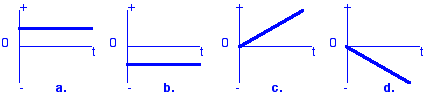
Given the choices above, answer the following
questions, 6-10:
6. Given
a plot of x vs. t as shown below, which of the graphs above depicts a plot of
velocity vs. t: a., b., c., d., or e.
none of the above?
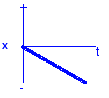
7. Given
the same plot of x vs. t as shown
in #6, which of the graphs above depicts a plot of acceleration vs. t: a., b., c., d.,
or e. none of the above?
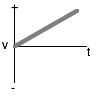
8. Given
a plot of velocity vs. t as shown below, which of the graphs above
depicts a plot of acceleration vs. t: a., b., c., d., or e. none of the above?
9. Given
a plot of x vs. t as shown below, which of the graphs above depicts a plot of
velocity vs. t: a., b., c., d., or e.
none of the above?
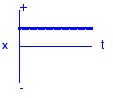
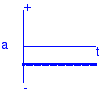
10. Given a plot of
acceleration vs. t as shown below, which of the previous graphs depicts a plot
of velocity vs. t: a., b.,
c., d., or e. none of the above?

11.
A projectile is shot in a direction 30 degrees below the horizontal from
a
height of 500m and initial speed of 50m/s, as
shown above. (Use g=9.81m/s2)
a. Write the initial velocity vector, vo,
as a vector in proper vector notation, using
the coordinate system given above.
b.
Calculate the time in sec. that it will take for the projectile to hit
the ground.
c.
Calculate the x position at which the projectile will hit the ground.
d.
Calculate the final velocity in the x-direction of the projectile just
before it hits
the ground, using
the coordinate system given above.
e.
Calculate the final velocity in the y-direction of the projectile just
before it hits
the ground, using
the coordinate system given above.
f. Calculate
the final speed (just before hitting the ground).
g. Calculate
the final angle the projectile makes with respect to the x-axis (just
before hitting the ground) (measured in a
clockwise direction).