Your Name: _______________________ PHY203
Exam
#1
Chapters
1-3
Thurs,
9/30/10
Lecture
Time: 9
a.m 1p.m. 2p.m. 3p.m. Honors
1-10 _________________ (out
of 50)
11 _________________ (out
of 20)
12 _________________ (out
of 30)
Total _______________
Multiple
choice answer sheet-shade in correct answers below
(one
choice per problem):
|
|
1 |
2 |
3 |
4 |
5 |
6 |
7 |
8 |
9 |
10 |
|
a |
|
|
|
|
|
|
|
|
|
|
|
b |
|
|
|
|
|
|
|
|
|
|
|
c |
|
|
|
|
|
|
|
|
|
|
|
d |
|
|
|
|
|
|
|
|
|
|
|
e |
|
|
|
|
|
|
|
|
|
|
1. The world record in swimming for the 1500 m
distance is 14 min., 35 sec. What was the average speed in miles per hour?
a. 0.064 mph
b. 3.84
mph
c. 9.90 mph
d. 38.4
mph
e. None
of the above
For questions 2-5, traveling in one direction, a
train starts from rest with an acceleration of 5 m/s2 for 20 s.
After 20 s, the train moves at constant speed for 50 s. Finally the train
accelerates at -4 m/s2 until it comes to rest.
2.
Find the distance the train travels in the first 20 s.
a. 50
m
b. 100
m
c. 1000
m
d. 2000 m
e. None
of the above
3.
Find the speed of the train after 20 s.
a. 50 m/s
b. 100
m/s
c. 200
m/s
d. 1000 m/s
e. None
of the above
4.
Find the distance the train travels from 20 s to 70 s.
a. 2500
m
b. 5000
m
c. 10,000 m
d. 50,000
m
e. None
of the above
5.
Find the distance the train travels from 70 s until it comes to rest.
a. 12.5
m
b. 625
m
c. 1250
m
d. 2500
m
e. None
of the above
6. A
bike rider rides 3 km East and then 7.5 km North. Find the magnitude of the
displacement of the rider at the end of the trip.
a. 3.2
km
b. 4.5
km
c. 8.1
km
d. 10.5
km
e. None
of the above
7. A
bike rider rides 4.5 km East and then 8.0 km North. Find the angle the
displacement of the rider makes with respect to
the East direction measured in a
counterclockwise direction from the positive East
axis at the end of the trip.
a. 29.4 o
b. 40.4
o
c. 60.6
o
d. 64.6
o
e. None
of the above
For problems 8-10, on Planet XXX, the acceleration due to gravity is
exactly 10 m/s2. Identical rocks are dropped from the top of a
cliff. Find the time, t, at which the rocks are side-by-side.
8. Case1: Rock a is dropped at t = 0; rock b is dropped from the top
of the cliff at t = 2 s.
a. 1.0
s
b. 2.0
s
c. 3.0 s
d. 4.0
s
e. None
of the above
9. Case 2: Rock a is
dropped at t = 0; rock b is thrown straight down at t = 2 s with an initial
speed of 40 m/s.
a. 1.0
s
b. 1.67
s
c. 3.0
s
d. 5.0 s
e. None
of the above
10. Case 3: Rock a is
thrown down with an initial speed of 10 m/s at t = 0; rock b is thrown straight
down at t = 2 with an initial speed of 40 m/s.
a. 1.2
s
b. 2.0
s
c. 6.0
s
d. 10.0 s
e. None
of the above
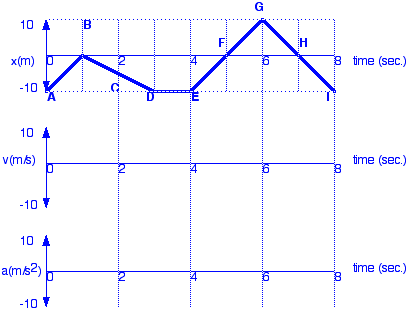
11. First,
fill in the plots above for v vs. t and a vs. t.
Show
your work below:
a.
Find the total distance traveled from points B-H.
b.
Find the average speed from points B-H.
c.
Find the average velocity from points B-H.
d.
Find the displacement from points G-I.
e.
Find the instantaneous velocity at point H.
f.
Find the average acceleration from points C-H.
12.
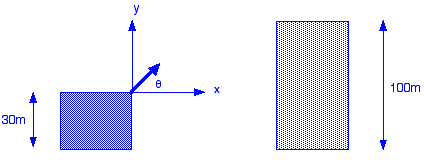
A boy who is standing on top of a 30 m tall building throws a ball at a
nearby building that is 100 m tall. The initial velocity in the x-direction
given to the ball is 30 m/s. When
the ball hits the top, left corner of the building, it is at the highest point
of its trajectory. Use g = 9.81 m/s2.
Show
your work below:
a.
Calculate the initial velocity of the ball in the y-direction.
b.
Calculate the initial speed of the ball.
c.
Calculate the angle the ball made initially with respect to the
horizontal (x) direction.
d. Write the initial velocity in vector notation
using the coordinate system shown above.
v0= (________________ i + _____________ j)
m/s
e. Calculate the time it takes for the ball to
reach the roof of the second building.
f.
Find the velocity of the ball just as it is hitting the roof and write
it in in vector notation using the coordinate system shown above.
Extras
For problems 8-11 consider two trains traveling in the same
direction on parallel tracks. The measurements start when they are 500m apart.
In all cases below, train 1 is traveling to the right and passes the position
x=0 at t=0 traveling in the positive x-direction at a constant speed of 5 m/s.
In all cases below, find the x position at which train 2 is parallel to train
1:
10.
Case 3: Train 2 starts from rest at the x=-500m position at t=0s traveling with
a constant magnitude of acceleration of 4 m/s2.
a. 85.6
m
b. 66m
c. 77.6m
d. 132m
e. None
of the above
11.
Case 3: Train 2 starts from rest at the x=-500m position at t=5s traveling with
a constant magnitude of acceleration of 4 m/s2.
a. 55m
b. 66m
c. 77.6m
d. 132m
e. None
of the above
For problems 12-15,
Let A = 6j, B = 3i - 4j, C = -3i - 5j, and D = 3A + 4B – 6k
12.
Find the magnitude of the vector A
and the angle that vector
A makes with
the positive x-axis (measured in a
counterclockwise direction from the positive x-
axis):
a. 6,
90o
b. 5.0, 0o
c. 2.23,
90o
d. 5.0,
90o
e. None
of the above
13.
Find the magnitude of the vector B
and the angle that vector
B makes with
the positive x-axis (measured in a
counterclockwise direction from the positive x-
axis):
a. 5,
301o
b. 3.3, 320.2o
c. 7.8,
309.8o
d. 7.8,
320.2o
e. None
of the above
14.
Find the magnitude of the vector C
and the angle that vector
C makes with
the positive x-axis (measured in a
counterclockwise direction from the positive x-
axis):
a. 5.8,
246.6o
b. 3.6, 236.3o
c. 3.6,
303.7o
d. 3.6,
326.3o
e. 5.0,
326.3o
15.
Find the magnitude of the vector D:
a. 13.6
b. 38.7
c. 41.4
d. 42.9
e. None
of the above
16. On Planet XXX where
the acceleration due to gravity is exactly 10m/s2, consider a ball
dropped from a cliff with a height of 200m. Find the distance the ball travels
in he last second before hitting the ground:
a. 58.5
m
b. 125m
c. 150m
d. 175m
e. None
of the above (never catches up)
17. On Planet XXX where
the acceleration due to gravity is exactly 10m/s2, consider a ball
thrown straight up with an initial speed of 5 m/s from a cliff. Find the distance
below the cliff the ball will be located after 10 sec.:
a. 450
m
b. 125m
c. 150m
d. 175m
e. None
of the above (never catches up)
7. Case 3: rock a is
dropped from the cliff at t=0 sec.; rock b is thrown straight up at t=5 sec.
with an initial speed of 5 m/s.
a. 3 sec.
b. 125m
c. 150m
d. 175m
e. None
of the above (never catches up)