Your Name: _______________________ PHY203
Final
Exam
5/11/09
Part 3
1-10 ________ (out of 60)
11 ________ (out of 40)
Total
_______
Multiple
choice answer sheet-shade in correct answers below
(one choice per problem):
|
|
1 |
2 |
3 |
4 |
5 |
6 |
7 |
8 |
9 |
10 |
|
a |
|
|
|
|
|
|
|
|
|
|
|
b |
|
|
|
|
|
|
|
|
|
|
|
c |
|
|
|
|
|
|
|
|
|
|
|
d |
|
|
|
|
|
|
|
|
|
|
|
e |
|
|
|
|
|
|
|
|
|
|
1.
Masses are placed as follows along the x-axis: 1kg at x=0, 2kg at x=1m,
and 3kg at x=2m, all connected by a massless rod. Find the x position of the center of mass:
a. 1.33m
b. 1.6m
c. 8.0m
d. 14.0m
e. none of
the above
2.
Masses are placed as follows along the x-axis: 1kg at x=0, 2kg at x=1m,
and 3kg at x=2m, all connected by a 5kg rod of length 3m starting at x=0. Find the x position of the center of
mass:
a. 1.4m
b. 1.55m
c. 2.1m
d. 15.5m
e.23.0m
For problems 3 and 4:
A 0.25kg ball traveling at a speed of 3.5m/s in
the positive x-direction strikes a wall and rebounds in the negative
x-direction with a speed of 2.5m/s.
3.
Find the magnitude of the impulse.
a. 0.25Ns
b. 1.0Ns
c. 1.5Ns
d. 6.0Ns
e. 24.0Ns
4.
Assuming the collision time is 1.0x10⁻³s, find the magnitude
of the average force during the collision.
a. 2.5x10⁻⁴N
b. 1.5x10⁻³N
c. 2.5x10+2N
d. 1.0x10+3N
e. 1.5x10+3N
5.
Let the vector A = 5i – 4j and B = -3i + 2k. Find the vector A x B:
a. -8i -10j - 12k
b. -8i -10j + 12k
c. -8i +10j - 12k
d. -8i +10j + 12k
e. +8i +10j + 12k
For problems 6-8:
A
solid sphere of mass 10kg and radius 0.5m is at rest. A force of 10N is applied
at the edge of the sphere in a direction perpendicular to the radius.
6.
Find the magnitude of the torque, t about the central axis of the sphere:
a. 0 Nm
b. 5.0 Nm
c. 10.0 Nm
d. 50.0 Nm
e. 100.0 Nm
7. Find the moment of inertia about the axis of
the sphere:
a. 0.25 kgm2
b. 1.0 kgm2
c. 1.67 kgm2
d. 2.0 kgm2
e. 4.0 kgm2
8.
Find the number of revolutions the sphere has made after the torque has
been applied for 15s.
a.
11.9
b. 75.0
c.
89.5
d. 179.0
e. 562.5
For problems 9 and 10:
A hoop (thin cylindrical shell) of mass 2kg and
radius 0.5m is rotating horizontally on a frictionless table with an angular
speed of 5rad/s.
9.
Find the magnitude of the angular momentum:
a. 1.25kgm2/s
b. 2.5kgm2/s
c. 5.0kgm2/s
d. 15.7kgm2/s
e. none of
the above
10. A blob of clay of mass 1.0kg is dropped onto
the rim of the hoop from above and sticks to the hoop. Find the magnitude of
the angular speed of the hoop-putty system after the putty has stuck to the
hoop:
a.
0.833rad/s
b. 2.5rad/s
c.
3.33rad/s
d. 5.0rad/s
e. 6.67rad/s
11.
Two masses are supported by a pulley, which can be modeled as a solid
cylinder, as shown below. The values are as follows: m1=4kg, m2=5kg,
Mpulley=7kg, Rpulley=0.5m. (Use g=9.81 m/s2.)
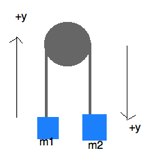
a.
Sketch and label the forces on the two masses on the picture above.
(Hint: the tensions in the rope on either
side are not equal in magnitude.)
b. Using
the coordinate systems shown above, write down Newton's 2nd Law for
the two masses in terms of g, the masses, the
tensions, and the acceleration, a.
c. Write down the torque equation for the pulley in terms of Mpulley,Rpulley, the tensions, and the acceleration, a..
d. Combine
the results of parts b-d to find the acceleration of the masses.
Exam #3
Crib
Sheet
Chapters
8-10
center of mass: Mtotrcm = m1r1 + m2r2+ m3r3 + ....
velocity of center of mass: Mtotvcm = m1v1 + m2v2+ m3v3 + ....
Fnet ext = Macm
momentum: p = mv
Conservation
of momentum (net external force = 0): pinitial = pfinal
Kinetic
energy, K = (1/2)mv2 K =
(1/2)Iw2 for rotating objects
K = (1/2)m vcm 2 + (1/2)Iw2 for objects rolling w.o slipping
For objects rolling w.o slipping, : vcm
= wr (cm =
center-of-mass)
Gravitational Potential Energy, U = mgh
Impulse:
I = Dp = FavDt
For
a vectors A,B,C with magnitude A,B,C
and direction:
If
C = A x B; C = ABsinq with direction of C given
by the right hand rule
i x j = k; j x k = i; k x i = j
moment
of inertia: I
= mr2 for a single particle
torque:
t = r x F
= Ia
angular
momentum: L
= r x p or L
= Iw where p = mv
parallel axis theorem: I = ICM + Mh2
For constant angular acceleration:
q = qo + wot
+ 1/2at2
w = wo + at
w2
= (wo )2 + 2a(Dq)
For rotating objects: vtan = wr
circumference
of a circle = 2pr