Your Name: _______________________ PHY203
Final
Exam
5/5/08
Part
3
1-10 ________ (out of 60)
11 ________ (out of 40)
Total _______
Multiple choice answer sheet-shade in
correct answers below
(one
choice per problem):
|
|
1 |
2 |
3 |
4 |
5 |
6 |
7 |
8 |
9 |
10 |
|
a |
|
|
|
|
|
|
|
|
|
|
|
b |
|
|
|
|
|
|
|
|
|
|
|
c |
|
|
|
|
|
|
|
|
|
|
|
d |
|
|
|
|
|
|
|
|
|
|
|
e |
|
|
|
|
|
|
|
|
|
|
1. A 10kg duck is flying North at 5m/s. A second duck of mass 5kg is flying North at 10m/s. Find the velocity of the center of mass:
a. 1.0 m/s
b. 3.0 m/s
c. 5.0 m/s
d. 6.67 m/s
e. 15.0 m/s
2. A wheel is spinning with a constant angular velocity of w=4 rad/s. Find the number of revolutions the wheel has made after 1 min.:
a. 0.64 rev
b. 19.1 rev
c. 38.2 rev
d. 76.4 rev
e. none of
the above
For problems 3-5:
A wheel is spinning with a constant angular velocity of w=40rad/s. A torque is applied to the wheel causing it to slow down to rest in 80 sec. The wheel is a solid disk of mass 2kg and radius 0.5m.
3. Find the moment of inertia of the wheel:
a. 0.125 kgm2
b. 0.25 kgm2
c. 0.5 kgm2
d. 1.0 kgm2
e. 25 kgm2
4. Find the angular acceleration of the wheel:
a. 0.5 rad/s2
b. 1.0
rad/s2
c. 2.0
rad/s2
d. 5.0
rad/s2
e. 20.0
rad/s2
5. Find the torque:
a. 0.0625
Nm
b. 0.125 Nm
c. 0.625 Nm
d. 1.25 Nm
e. none of
the above
6.
Let the vector A = 5i – 4j and B = 3i. Find the vector C = A
x B:
a. -12k
b. +12k
c. -15i - 12k
d. -15i + 12k
e. 15i - 12k
For problems 7-9:
2 bicycles collide and get tangled up so they keep moving together after the collision. Before the collision, one bike (mass=100kg) is traveling East at 10m/s. The second bike (mass=75kg) is traveling West at 20m/s.
7. Find the total momentum of the bikes before the collision:
a. East at 500 kgm/s.
b. West at 500 kgm/s.
c. East at
2500 kgm/s.
d. West at
2500 kgm/s.
e. none of
the above
8. Find the total momentum of the bikes after the collision:
a. Same as
in #7
b. Same magnitude as in #7, opposite direction.
c. 1/2 of the answer in #7.
d. twice the answer in #7.
e. Not enough information is given.
9. Find the velocity of the tangled up bikes after the collision:
a. East at 2.9 m/s.
b. West at 2.9 m/s.
c. East at 14.3 m/s.
d. West at
14.3 m/s.
e. West at
15.0 m/s.
10. Young Albert Einstein is playing with a model train set. He gets the train (mass 3kg) going at a speed of 4m/s along a straight section of track. As the train passes by him, he drops a stone (mass 0.5kg) which lands on the train and stays there. Find the speed of the train after the stone has landed:
a. 2.4 m/s
b. 3.4 m/s
c. 4.0 m/s
d. 4.8 m/s
e. none of
the above
11. A ball of mass 2kg traveling at a speed of 5m/s strikes a rod of length 3m and
mass 4kg and sticks to it. The rod is hanging from and pivots about an axis at its top
end (labeled A).
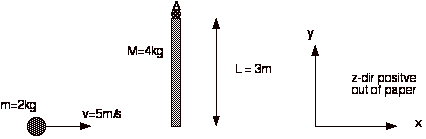
a.
Calculate the momentum of the ball before the collision and express it
in vector
notation, assuming the ball is initially
traveling in the positive x-direction.
b.
Calculate the angular momentum of the system about point A just before
the
collision and express it in vector notation,
assuming out-of-the-paper is the positive
z-direction.
c.
Find the angular momentum of the system after the collision as a vector.
d. Calculate
the moment of inertia of the rod about its end before the collision.
e. Calculate
the moment of inertia of the ball+rod system after the collision.
f. Calculate the angular
velocity of the ball+rod system after the collision.
Exam #3
Crib Sheet
Chapters 8-10
center of mass: Mtotrcm = m1r1 + m2r2+ m3r3 + ....
velocity of center of mass: Mtotvcm = m1v1 + m2v2+ m3v3 + ....
Fnet ext = Macm
momentum:
p = mv
Conservation
of momentum (net external force = 0): pinitial = pfinal
Kinetic
energy, K = (1/2)mv2 K =
(1/2)Iw2 for
rotating objects
K = (1/2)m vcm 2 + (1/2)Iw2 for objects
rolling w.o slipping
For objects rolling w.o slipping, : vcm
= wr (cm =
center-of-mass)
Gravitational Potential Energy, U = mgh
Impulse:
I = Dp = FavDt
For
a vectors A,B,C with magnitude
A,B,C and direction:
If
C = A x B;
C = ABsinq with direction of C given
by the right hand rule
i x j = k; j x k = i;
k x i = j
moment
of inertia: I
= mr2 for a single particle
torque:
t
= r x F
= Ia
angular
momentum: L = r
x p or L
= Iw where p = mv
parallel axis theorem: I = ICM + Mh2
For constant angular acceleration:
q = qo
+ wot + 1/2at2
w = wo
+ at
w2
= (wo )2 + 2a(Dq)
For rotating objects: vtan = wr
circumference
of a circle = 2pr