Your Name: _______________________ PHY203
Final
Exam
5/11/09
Part 1
1-10 ________ (out of 70)
11 ________ (out of 30)
Total
_______
Multiple
choice answer sheet-shade in correct answers below
(one choice per problem):
|
|
1 |
2 |
3 |
4 |
5 |
6 |
7 |
8 |
9 |
10 |
|
a |
|
|
|
|
|
|
|
|
|
|
|
b |
|
|
|
|
|
|
|
|
|
|
|
c |
|
|
|
|
|
|
|
|
|
|
|
d |
|
|
|
|
|
|
|
|
|
|
|
e |
|
|
|
|
|
|
|
|
|
|
PHY203
Crib
Sheet
Chapters
1-3
speedAV = (total distance traveled)/Dt
Dx
= x2 – x1 (displacement)
vAV = Dx/Dt
aAV = Dv/Dt
vInst = dx/dt
aInst = dv/dt
For constant acceleration:
xf = xo + vot
+ (1/2)at2
vf = vo + at
Vf2 = vo2 +
2a(xf - xo)
g = 9.81 m/s2, the
acceleration due to gravity (on Earth), unless otherwise directed
For a vector A
with magnitude A and direction q (measured counterclockwise with respect to the
x-axis):
Ax = Acos(q)
Ay = Asin(q)
A = (Ax2 + Ay2)1/2
tan(q) = Ay/Ax
quadratic eq. sol.: If ax2 + bx + c = 0; then x =[ -b+(b2-4ac)1/2]/(2a)
1. Convert the speed of light, 3x10⁸m/s to
teramiles/hour:
a. 5.2x10⁻¹¹
Tmi/h
b. 6.7x10⁻⁴
Tmi/h
c. 1.7x10⁻³
Tmi/h
d. 6.7x10+4
Tmi/h
e. None
of the above
For problems 2-5,
Let A = 5i, B = 5i - 6j, C = -2i - 3j, and D = 2A + 3B – 8C
2.
Find the magnitude of the vector A
and the angle that vector
A makes with the
positive x-axis (measured in a counterclockwise
direction from the positive x-
axis):
a. 2.23,
0o
b. 5.0, 0o
c. 2.23,
90o
d. 5.0,
90o
e. None
of the above
3.
Find the magnitude of the vector B
and the angle that vector
B makes with the
positive x-axis (measured in a counterclockwise
direction from the positive x-
axis):
a. 3.3,
309.8o
b. 3.3, 320.2o
c. 7.8,
309.8o
d. 7.8,
320.2o
e. None
of the above
4.
Find the magnitude of the vector C
and the angle that vector
C makes with the
positive x-axis (measured in a counterclockwise
direction from the positive x-
axis):
a. 3.6,
214o
b. 3.6, 236.3o
c. 3.6,
303.7o
d. 3.6,
326.3o
e. 5.0,
326.3o
5.
Find the magnitude of the vector D:
a. 36.5
b. 38.7
c. 41.4
d. 42.9
e. None
of the above
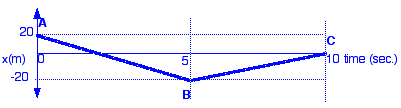
6. For the above graph, find the average
speed and average velocity from positions A to C:
a. 2m/s,
-2m/s
b. 6m/s,
-2m/s
c. 6m/s,
+2m/s
d. 6m/s,
+6m/s
e. None
of the above
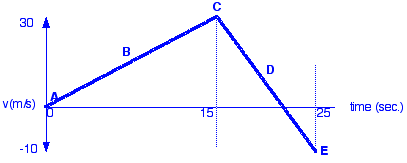
7. For the above graph, find the
instantaneous acceleration at point B and at point D:
a. 2.0
m/s2, -4.0 m/s2
b. 2.0
m/s2, -1.6 m/s2
c. 2.0
m/s2, +1.6 m/s2
d. 2.0
m/s2, +4.0 m/s2
e. None
of the above
8. For the above graph, find the average
acceleration from A to E.:
a. -3.0
m/s2
b. -2.0
m/s2
c. -1.0
m/s2
d. -0.4
m/s2
e. None
of the above
A missile on Planet 203-X (with g = 10 m/s2
exactly) is shot from a cliff with
height 250m and initial speed of 60m/s and an
angle of 75o, as
shown below.
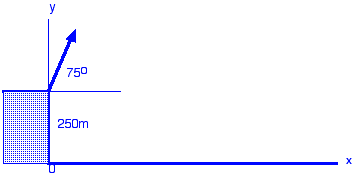
9.
Calculate the time in sec. that it will take for the missile to reach
its highest point.
a. 1.2
sec.
b. 1.55
sec.
c. 5.8
sec.
d. 16.8
sec.
e. None
of the above
10.
Calculate the total time from launch for the missile to hit the ground.
a. 3.35
sec.
b. 5.7
sec.
c. 8.8
sec.
d. 14.9
sec.
e. None
of the above
11.
Consider a rocket being launched from rest straight up into the
atmosphere.
In the first stage, the rocket accelerates at 30m/s2 for 20s. Then the motor cuts off and the rocket continues to travel upwards for a while. (Use g=9.81m/s2)
a. Find the height of the rocket when the motor cuts off.
b. Find the speed of the rocket when the motor cuts off.
c. Find the height of the rocket at which it stops traveling upwards and begins to descend.
d. Find the total time the rocket has been in the air before it stops traveling upwards and begins to descend.
e. Find the total time the rocket is in the air before it hits the ground.
f. Find the speed of the rocket just before it hits the ground.
Extras
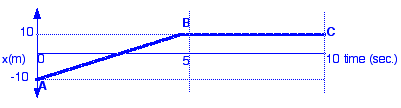
17. For the above graph, find the distance
and displacement from positions A to C:
a. 20m,
20m
b. -10.0
m/s2
c. -5.0
m/s2
d. 0
m/s2
e. None
of the above
18. For the above graph, find the average
speed and average velocity from positions A to C:
a. 2m/s,
2m/s
b. -10.0
m/s2
c. -5.0
m/s2
d. 0
m/s2
e. None
of the above