Your Name: _______________________ PHY203
Final
Exam
12/14/07
Lecture Time: 9
a.m 1p.m. 2p.m. 3p.m. Honors
Part
1
1-10 ________ (out of 50)
11 ________ (out of 50)
Total _______
Multiple choice answer sheet-shade in
correct answers below
(one
choice per problem):
|
|
1 |
2 |
3 |
4 |
5 |
6 |
7 |
8 |
9 |
10 |
|
a |
|
|
|
|
|
|
|
|
|
|
|
b |
|
|
|
|
|
|
|
|
|
|
|
c |
|
|
|
|
|
|
|
|
|
|
|
d |
|
|
|
|
|
|
|
|
|
|
|
e |
|
|
|
|
|
|
|
|
|
|
For problems 1-3,
Let A = 6i
- 5j, B = -7i + 10j, C = 3A – 2B
1.
Write the vector, C,
in vector notation:
a. 4i - 5j
b. 4i + 5j
c. 32i + 5j
d. 32i - 35j
e. None
of the above
2.
Find the magnitude of the vector B:
a. 3.0
b. 7.1
c. 12.2
d. 17.0
e. None
of the above
3.
Find the angle that vector A
makes with the positive x-axis (measured in a
counterclockwise direction from the positive
x-axis):
a. 40o
b. 50o
c. 310o
d. 320o
e. None
of the above
4. A
bike rider starts from rest with an acceleration of 0.066 m/s2. Find
how long it
takes the bike rider to ride 1.0 km:
a. 2.9
min.
b. 5.5
min.
c. 5.8
min.
d. 253
min.
e. None
of the above
5. Consider two trains running in the same
direction on parallel tracks.
Train 1 passes the station at time, t = 0, with a constant speed of 5
m/s. Train 2 passes the station 30 seconds later than train 1 at a constant
speed of 6 m/s. Find the time, t, at which the trains are exactly side-by-side:
a. 16.4
sec.
b. 150
sec.
c. 180
sec.
d. 210
sec.
e. None
of the above
6. A
police officer gives a burst of the car’s siren as the car is traveling
towards a wall
at a speed of 100 m/s. The officer hears the
siren sound reflected from the wall 1.0
sec. later.
Find the distance the car was at the time the siren was sounded. (Use
343
m/s as the speed of sound in air):
a. 172
m
b. 221.5
m
c. 243
m
d. 343
m
e. None
of the above
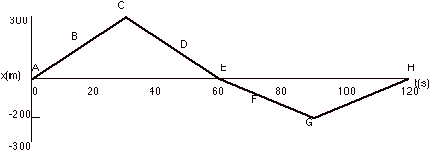
For problems 7-10, refer to the plot above:
7.
Find the average speed from points C-G:
a. -8.3
m/s
b. -1.7
m/s
c. 1.7
m/s
d. 8.3
m/s
e. None
of the above
8.
Find the average velocity from points A-G:
a. -8.9
m/s
b. -2.2
m/s
c. 2.2
m/s
d. 8.9
m/s
e. None
of the above
9.
Find the instantaneous velocity at point D:
a. 0
b. -6.7
m/s
c. -5
m/s
d. -2.2
m/s
e. None
of the above
10.
Find the instantaneous acceleration at point F:
a. -6.67
m/s2
b. -5
m/s2
c. -2.22
m/s2
d. 0
e. None
of the above
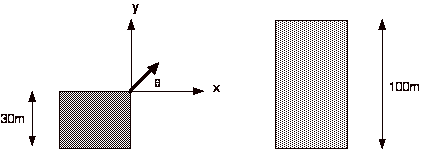
11. A boy who is
standing on top of a 30m tall building throws a ball at a nearby building that
is 100m tall. The initial velocity in the x-direction given to the ball is 30
m/s. When the ball lands on the
roof of the second building it is traveling only in the horizontal direction. Show your work. (Note: use g = 9.81 m/s2).
a.
Calculate the initial velocity of the ball in the y-direction.
b.
Calculate the initial speed of the ball and the angle the ball made initially with respect
to the horizontal (x-) direction.
c. Calculate the time it takes for the ball to
reach the roof of the second building.
d.
Write the velocity of the ball just as it is hitting the roof in vector
notation using the coordinate system given above.
e. If
the second building were not in the way, calculate how long it would take for the ball to hit the ground.
PHY203
Crib
Sheet
Chapters
1-3
speedAV
= (total distance traveled)/Dt
Dx = x2 – x1 (displacement)
vAV
= Dx/Dt
aAV
= Dv/Dt
vInst
= dx/dt
aInst
= dv/dt
For constant acceleration:
xf = xo
+ vot + (1/2)at2
vf = vo
+ at
Vf2 =
vo2 + 2a(xf - xo)
g = 9.81 m/s2, the acceleration due to gravity (on Earth), unless otherwise
directed
For a vector A with magnitude A and direction q
(measured counterclockwise with respect to the x-axis):
Ax = Acos(q)
Ay = Asin(q)
A = (Ax2 + Ay2)1/2
tan(q) = Ay/Ax
quadratic eq. sol.: If ax2 + bx + c = 0; then x =[ -b+(b2-4ac)1/2]/(2a)