Your Name:
_______________________ PHY203
Final
Exam
Student ID:
________________________ Chapters
1-12,14
12/12/03
Lecture Time: 9
a.m 1p.m. 2p.m. 3p.m. Honors
Part 1 Part
2
#Incorrect =( ______) #Incorrect
=( ______)
|
|
1 |
2 |
3 |
4 |
5 |
6 |
7 |
8 |
9 |
10 |
11 |
12 |
X
|
1 |
2 |
3 |
4 |
5 |
6 |
7 |
8 |
9 |
10 |
11 |
12 |
|
a |
o |
o |
o |
o |
o |
o |
o |
o |
o |
o |
o |
o |
X |
o |
o |
o |
o |
o |
o |
o |
o |
o |
o |
o |
o |
|
b |
o |
o |
o |
o |
o |
o |
o |
o |
o |
o |
o |
o |
X |
o |
o |
o |
o |
o |
o |
o |
o |
o |
o |
o |
o |
|
c |
o |
o |
o |
o |
o |
o |
o |
o |
o |
o |
o |
o |
X |
o |
o |
o |
o |
o |
o |
o |
o |
o |
o |
o |
o |
|
d |
o |
o |
o |
o |
o |
o |
o |
o |
o |
o |
o |
o |
X |
o |
o |
o |
o |
o |
o |
o |
o |
o |
o |
o |
o |
|
e |
o |
o |
o |
o |
o |
o |
o |
o |
o |
o |
o |
o |
X |
o |
o |
o |
o |
o |
o |
o |
o |
o |
o |
o |
o |
Part 3 Part
4
#Incorrect =( ______) #Incorrect
=( ______)
|
|
1 |
2 |
3 |
4 |
5 |
6 |
7 |
8 |
9 |
10 |
11 |
12 |
X
|
1 |
2 |
3 |
4 |
5 |
6 |
7 |
8 |
9 |
10 |
11 |
12 |
|
a |
o |
o |
o |
o |
o |
o |
o |
o |
o |
o |
o |
o |
X |
o |
o |
o |
o |
o |
o |
o |
o |
o |
o |
o |
o |
|
b |
o |
o |
o |
o |
o |
o |
o |
o |
o |
o |
o |
o |
X |
o |
o |
o |
o |
o |
o |
o |
o |
o |
o |
o |
o |
|
c |
o |
o |
o |
o |
o |
o |
o |
o |
o |
o |
o |
o |
X |
o |
o |
o |
o |
o |
o |
o |
o |
o |
o |
o |
o |
|
d |
o |
o |
o |
o |
o |
o |
o |
o |
o |
o |
o |
o |
X |
o |
o |
o |
o |
o |
o |
o |
o |
o |
o |
o |
o |
|
e |
o |
o |
o |
o |
o |
o |
o |
o |
o |
o |
o |
o |
X |
o |
o |
o |
o |
o |
o |
o |
o |
o |
o |
o |
o |
Your Name: _______________________ PHY203
Final
Exam
Student ID:
________________________ Chapters
1-12,14
12/12/03
Part 1
Part 2
1. A
block of mass 5 kg is attached to a spring and sitting on a horizontal
frictionless surface. It requires a force of 10 N to stretch the spring by 10
cm. Calculate the spring constant
of the spring:
a. 1.0
N.m
b. 2.0 N.m
c. 20
N.m
d. 100
N.m
e. 1000
N.m
(For Problems 2 and 3)
A 2 kg mass is attached
to a string and spun around on a frictionless horizontal surface fast enough such that the centripetal
acceleration is 5g.
2. Calculate
the magnitude of the centripetal force:
a. 5
N
b. 24.5
N
c. 49.0
N
d. 98.1
N
e. 196.2
N
3. If
the radius of the circle is 0.5 m, calculate the speed of the mass:
a. 2.48
m/s
b. 3.50
m/s
c. 4.95
m/s
d. 7.00
m/s
e. 9.90
m/s
(For
problems 4 and 5)
A block of mass 10 kg is
on a rough surface. The maximum (or critical) frictional force is 20N. The kinetic frictional force is 15N.
4. You
pull on the block with a horizontal force of 10N in the positive x direction;
calculate the magnitude of the acceleration of the block:
a. 0
m/s2
b. 0.5
m/s2
c. 1.0
m/s2
d. 1.5
m/s2
e. 2.0
m/s2
5. You
pull on the block with a horizontal force of 50N in the positive x direction;
calculate the magnitude of the acceleration:
a. 3.0
m/s2
b. 3.5
m/s2
c. 5.0
m/s2
d. 6.0
m/s2
e. 7.0
m/s2
(For
problems 6 and 7)
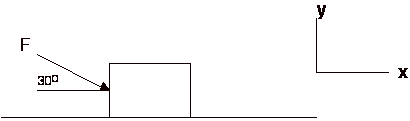
An external force, F, of magnitude 10N is applied
to a 20kg block at an angle of 30o with
respect
to the horizontal, as shown below. Assume the surface under the mass is
frictionless.
6. Calculate
the normal force on the block :
a. 187.5
N
b. 191.2
N
c. 196.2
N
d. 201.2
N
e. 204.9
N
7. Calculate
the acceleration of the block in the x-direction:
a. 0.25
m/s2
b. 0.43
m/s2
c. 0.50
m/s2
d. 0.58
m/s2
e. 1.0
m/s2
(For problems 8 and 9)
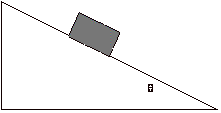
A block of mass 15 kg slides down a frictionless
ramp making an angle of q = 30o with the
horizontal, as shown below.
8. Calculate the acceleration of the block down the ramp.
a. 2.45
m/s2
b. 4.9
m/s2
c. 8.5
m/s2
d. 9.8
m/s2
e. 73.5
m/s2
9.
Calculate how far the block will travel along the ramp from rest in a time
of 1.5 s:
a. 2.78
m
b. 5.5 m
c. 9.6
m
d. 11
m
e. 83
m
(For problems 10-12)
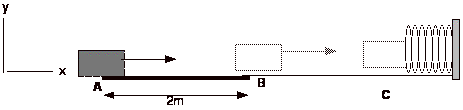
A block of mass 5.0 kg
has a speed of 10 m/s at point A. The block slides 2 meters on a rough surface which has a kinetic friction coefficient
of mk
= 0.25. The block travels 2 meters over a frictionless surface between points B and C and then
encounters a spring with spring constant, k=8000 N/m.
10. Calculate the kinetic energy of the block at point A:
a. 25
J
b. 50 J
c. 125
J
d. 250
J
e. 500
J
11. Calculate
the energy converted by friction to heat by the block sliding on the rough
surface:
a. 6.1
J
b. 12.3
J
c. 24.5
J
d. 49.0
J
e. 98.1
J
12. Calculate
compression of the spring when the block comes (momentarily) to rest:
a. 0.028
m
b. 0.031
m
c. 0.24
m
d. 0.25
m
e. 0.75
m
PHY203
Final
Exam, F/03
Crib
Sheet #2
Chapters 4-7
(Note: Use 9.81 m/s2 for g, the acceleration due to gravity.)
For constant acceleration(in one
dimension):
xf = xo
+ vot + (1/2)at2
vf = vo
+ at
vf2 =
vo2 + 2a(xf - xo)
(Note: Bold letters indicate vectors
below.)
F = ma
spring force: F = -kDx ,
where k is the spring constant
weight: W = mg
friction force:
kinetic fk = mkFn ,
where Fn is the normal force and mk is
the
kinetic frictional coefficient
static fs < msFn,
fsmax = msFn
uniform circular motion
centripetal acceleration: a = v2/R
Work and Energy
W = F .
d = Fdcosq
Work done by friction = -fkDs
EThermal =
|Work done by friction|
Kinetic Energy: K = (1/2)mv2
Potential Energy: Uspring = (1/2)kx2
Ugrav
= mgh
Total energy, E, is conserved ( a constant).
Power = Work/Time