Your Name: _______________________ PHY203
Final
Exam
Student ID: ________________________ Chapters
1-12,14
12/17/04
11:30-2:30 p.m.
Lecture Time: 9
a.m 1p.m. 2p.m. 3p.m. Honors
1 _________________ 7 __________________
2 _________________ 8 __________________
Part 1 (out of
100)____________ Part 4 (out of 100)____________
3 _________________
4 _________________
Total
(out of 400)_______________
Part 2 (out of 100)____________
5 _________________
6 _________________
Part 3 (out of 100)____________
Your Name: _______________________
1.
For the graphs above, indicate the graphs which
meet the following conditions:
a. acceleration
is constant
b. acceleration
is not constant
c. velocity
is constant
d. velocity
reverses its direction
e. Which
graphs of position, velocity, and acceleration are mutually consistent?
Your Name: _______________________
2. A
missile is shot in a horizontal direction from a cliff with height 20m and
initial speed of 100m/s, as shown. (Note: Use 9.81 m/s2 for the magnitude of g.)
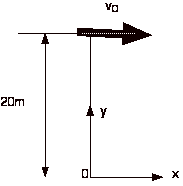
a.
Write the initial velocity vector, vo,
in vector notation.
b.
Calculate the time in sec. that it will take for the missile to hit the
ground.
c.
Calculate the x position at which the missile will hit the ground.
d.
Calculate the final velocity, vf,
of the missile just before it hits the ground (and present it in vector form).
e.
Calculate the final speed of the missile just before it hits the ground.
PHY203
Crib
Sheet
Chapters
1-3
1D case:
speedAV
= (total distance traveled)/Dt
vAV = Dx/Dt
aAV = Dv/Dt
vInst = dx/dt
aInst = dv/dt
For constant acceleration:
xf = xo
+ vot + (1/2)at2
vf = vo
+ at
Vf2 =
vo2 + 2a(xf - xo)
(Note: Use 9.81 m/s2 for g, the acceleration due to gravity.)
For a vector A with magnitude A and direction q
(measured counterclockwise with respect to the x-axis):
Ax = Acos(q)
Ay = Asin(q)
A = (Ax2 + Ay2)1/2
tan(q) = Ay/Ax
quadratic eq. sol.: If ax2 + bx + c = 0; then x = -b+(b2-4ac)1/2/(2a)
PHY203
Crib
Sheet
Chapters 4-7
(Note: Use 9.81 m/s2 for g, the acceleration due to gravity.)
For constant acceleration(in one
dimension):
xf = xo
+ vot + (1/2)at2
vf = vo
+ at
vf2 =
vo2 + 2a(xf - xo)
(Note: Bold letters indicate vectors below.)
F
= ma
spring force: F = -kDx ,
where k is the spring constant
weight: W = mg
friction force:
kinetic fk = mkFn ,
where Fn is the normal force and mk is the
kinetic frictional coefficient
static fs < msFn,
fsmax = msFn
uniform circular motion
centripetal acceleration: a = v2/R
Work and Energy
W = F
. d = Fdcosq
Work done by friction = -fkDs
EThermal =
|Work done by friction|
Kinetic Energy: K = (1/2)mv2
Potential Energy: Uspring = (1/2)kx2
Ugrav
= mgh
Total energy, E, is conserved ( a constant).