Your Name: _______________________ PHY203
Final
Exam
Wed.,
12/14/05
Lecture Time: 9
a.m 1p.m. 2p.m. 3p.m. Honors
Part
1
Part 1
1-10 ________ (out of 50)
(5 x ____ )
11 ________ (out of 50)
Total _______
Multiple choice answer sheet-shade in
correct answers below
(one
choice per problem):
|
|
1 |
2 |
3 |
4 |
5 |
6 |
7 |
8 |
9 |
10 |
|
a |
|
|
|
|
|
|
|
|
|
|
|
b |
|
|
|
|
|
|
|
|
|
|
|
c |
|
|
|
|
|
|
|
|
|
|
|
d |
|
|
|
|
|
|
|
|
|
|
|
e |
|
|
|
|
|
|
|
|
|
|
For questions 1 and 2:
At
t = 0, the speed of an object starting from the origin is 40 m/s at an angle of
45o with respect to the x-axis. At t=5 sec., the particle is at x= -15m
and y= 20m with a speed of 35 m/s at an angle of 30o with respect to the x-axis.
1. Find
the average velocity over the time interval:
a. -1
m/s
b. 15
m/s
c. 37.5
m/s
d. -3
m/s i +4 m/s j
e. 3
m/s i –4 m/s j
2. Find
the average acceleration over the time interval:
a. -1
m/s2
b. 15
m/s2
c. -15
m/s2
d. 5
m/s2 i
–10.8 m/s2
j
e. 1
m/s2 i
–2.2 m/s2
j
For questions 3-5:
A man runs 5 km in 30
min., then walks halfway back to the starting point in an additional 30
min.
3. Find
the total displacement:
a. 2500
m
b. -2500
m
c. 7500
m
d. -7500
m
e. 0
m
4. Find
the total average speed:
a. 0
m/s
b. 0.69
m/s
c. -0.69
m/s
d. 2.1
m/s
e. -2.1
m/s
5. Find
the total average velocity:
a. 0
m/s
b. 0.69
m/s
c. -0.69
m/s
d. 2.1
m/s
e. -2.1
m/s
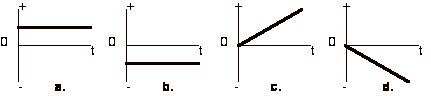
Given the choices above, answer the following
questions, 6-10:
6. Given
a plot of x vs. t as shown below, which of the graphs above depicts a plot of v
vs. t: a.,
b., c., d., or e. none of the above?
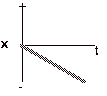
7. Given
the same plot of x vs. t as shown in #6, which of the graphs above depicts a
plot of a vs. t: a.,
b., c., d., or e. none of the above?
8. Given
a plot of v vs. t as shown below, which of the graphs above depicts a plot of a
vs. t: a.,
b., c., d., or e. none of the above?

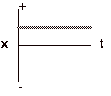
9. Given
a plot of x vs. t as shown below, which of the graphs above depicts a plot of v
vs. t: a.,
b., c., d., or e. none of the above?
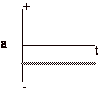
10. Given a plot of a
vs. t as shown below, which of the graphs above depicts a plot of v vs. t: a.,
b., c., d., or e. none of the above?
Your Name:
_______________________
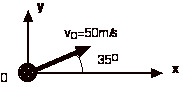
11.
A projectile is shot in a direction 35 degrees above the horizontal at
an initial
speed of 50m/s, as shown above. (Note: Use
9.81 m/s2 for the
magnitude of g, the acceleration due to gravity.)
a. Write the initial velocity vector, vo, in vector notation.
b.
Calculate the time in sec. that it will take for the projectile to reach
its highest point.
c.
Calculate the height of the projectile at its highest point
d.
Calculate the x position of the projectile at its highest point
e.
Write down the velocity of the projectile at its highest point in
correct vector
notation.
PHY203
Exam
#1
Crib
Sheet
Chapters
1-3
speedAV
= (total distance traveled)/Dt
Dx = x2 – x1 (displacement)
vAV
= Dx/Dt
aAV
= Dv/Dt
vInst
= dx/dt
aInst
= dv/dt
For constant acceleration:
xf = xo
+ vot + (1/2)at2
vf = vo
+ at
Vf2 =
vo2 + 2a(xf - xo)
g = 9.81 m/s2, the acceleration due to gravity
For a vector A with magnitude A and direction q
(measured counterclockwise with respect to the x-axis):
Ax = Acos(q)
Ay = Asin(q)
A = (Ax2 + Ay2)1/2
tan(q) = Ay/Ax
quadratic eq. sol.: If ax2 + bx + c = 0; then x = -b+(b2-4ac)1/2/(2a)