Your Name:
_______________________ PHY203
Exam
#3
Student ID: ________________________ Chapters
8-10,12
Tues.,
4/17/01
Lecture Time: 1p.m. 2p.m.
1. A 2kg block is traveling along in the positive
x-direction at an initial speed of 5m/s. A 1kg block traveling in the negative
y-direction with an initial speed of
4 m/s collides with the 2 kg block and sticks.
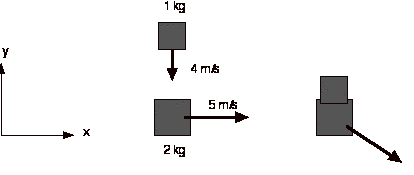
a. Using the
coordinate system shown above, find both the x and components
(magnitude and sign) of the total momentum just before the
collision.
b. What
are the x and y components of the momentum of the 2-block system
after the collision?
c. Find the x and y components (magnitude and direction) of the velocity of the
2-block system just after the collision has taken place.
d. Find
the change in kinetic energy of the system before and after the collision.
2. A
disk of mass 10 kg and radius 0.5 m is at rest. A force of 10 N is applied at
the edge of the disk at an angle of 60o as shown.
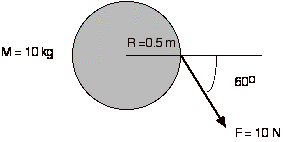
a. Find the
magnitude of the torque, t.
Will the torque cause the disk to rotate in a clockwise or
counterclockwise direction?
b. Calculate the
moment of inertia, I, of the disk.
c. Calculate
the angular acceleration, a, of the disk.
d. Calculate
the total angular rotation, q, in radians that the disk makes after the
torque has been applied for 10 seconds.
e. Calculate
how many revolutions the disk makes in the same 10 seconds.
3. A ball of mass 2kg traveling at a speed of 2m/s strikes a rod of length 2m and mass 3 kg and sticks to it. The rod is hanging from and pivots about an axis at its top end (labeled A).
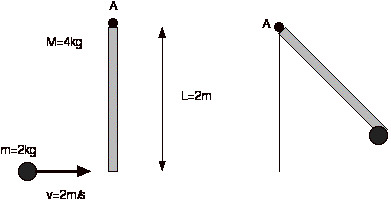
a. Calculate
the moment of inertia of the rod about its end.
b. Calculate
the angular momentum of the system about point A just before the collision.
c. What
is the angular momentum of the system after the collision?
d. Calculate
the moment of inertia of the ball+rod system.
e. Calculate
the angular velocity of the ball+rod system after the collision.
f. Calculate
the kinetic energy of the system just before and after the collision.
5. A
ball with mass 1kg and speed 2m/s traveling in the positive x-direction hits
and sticks to a block with mass 2kg and initial
speed 1m/s in the same direction.

a. Calculate
the initial momentum of the ball plus block system just before the collision
and write it in vector form.
b. What
is the momentum of the system just after the collision?
c. Calculate
the velocity to the ball+block combo after the collision and write it in vector
form.
d. Calculate
the kinetic energy of the system before and after the collision.
6. A
ball of mass 2kg is suspended from a hinged massless bar 1m in length and two
strings, as shown below.
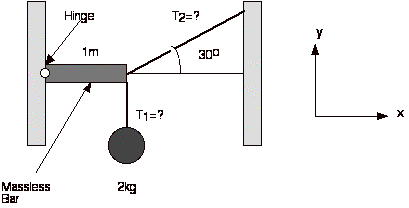
a. On
the diagram above, sketch the forces on the bar due to the wall.
b. Calculate
the tension in the lower string, T1.
c. Using
the coordinate system given above, write down Newton’s equations for the
x- and y-components of the forces on the massless bar.
d. Write
down the torque equation for the bar pivoting about the hinge.
e. Use
the torque equation from part c., to calculate the tension in the upper string,
T2.
f. Calculate
the x- and y-components of the force of the wall on the bar and write this
force in vector form.
PHY203
Exam
#3
Crib
Sheet
Chapters
8-10,12
(Note: Use 9.81 m/s2 for g, the acceleration due to gravity.)
For a vectors A,B,C with magnitude A,B,C and direction:
If C
= A x B ; C = ABsinq with direction of C given by the right hand rule
torque: t
= r x F
angular momentum: L = r
x p p
= mv
parallel axis theorem: I
= ICM + Mh2