Your Name:
_______________________ PHY203
Exam
#3
Student ID: ________________________ Chapters
6-8
Thurs.,
11/01/01
Lecture Time: 9
a.m 1p.m. 2p.m. 3p.m. Honors
Score:
1 _________________
2 _________________
3 _________________
+ 1
Total _______________
1. A
ball of mass 5.0 kg is traveling in the negative y direction. At a height of
2.0m above the ground the speed of the ball is 5.0m/s. At a height of 1.0m above the ground
the ball hits an uncompressed massless spring. The spring is compressed by 0.5m before the ball stops
(momentarily), as shown below.
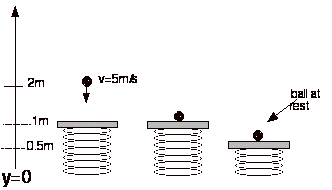
a. Calculate
the kinetic, K, potential, U, and total energy, E, of the system for the ball
at a height of 2.0m. (Take U=0 at ground level, y=0.)
b. Using
conservation of energy, calculate the speed of the ball when it just hits the
spring at a height of 1.0m.
c. Using
conservation of energy when the ball stops, calculate the spring
constant
of the spring.
2. A
block of mass 5.0 kg is traveling in positive x direction on a frictionless
surface with a speed of 8.0m/s. At point A, the block encounters a rough patch of 2.0m in length with a
kinetic coefficient of friction of 0.2. At point B then it begins sliding up a frictionless ramp until it stops (before sliding back down)
at point C.
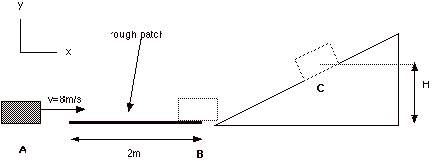
a. Calculate
the kinetic, K, potential, U, and total energy, E, of the system for the block
at point A. (Take y=0 at
ground level.)
b. Calculate the
mechanical energy lost to friction between points A and B.
c. Calculate
the velocity of the block at point B.
d. Using
conservation of energy, find the height, H, at which the block stops (at point C).
3. A
3.0kg block is traveling in the positive x-direction on a horizontal,
frictionless surface at an initial speed of 5.0m/s. The block explodes and
breaks into 2 pieces. One piece (m1
= 2.0kg) shoots off in the negative y direction with speed of 4.0m/s. (Note: all of the action below is on a
horizontal plane-i.e.the blocks do not fall; gravity is not important.)
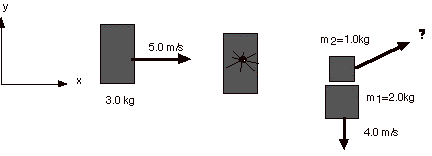
a. Using the
coordinate system shown above, calculate the initial momentum and kinetic
energy of the block before the explosion.
Write the momentum in vector notation.
b. Find the velocity of the second block ( m2) after the explosion and write it in vector notation.
c. Calculate the final kinetic energy of the system.
5. A
block of mass m=7.0 kg is traveling in the positive x direction on a
frictionless surface with a speed of vo=4.0m/s.
The block encounters a force F=50N which is applied over a distance of d=2m at
an angle of 60o with respect to the horizontal, as shown
below. After the force has been
removed, the block hits a spring which has a force constant of k=500 N/m.
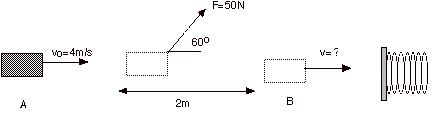
a. Calculate
the kinetic energy, K, of the block at point A.
b. Calculate the
work, W, done on the block by the force, F.
c. Using
work and energy, calculate the velocity, v, of the block at point B.
d. Calculate
the distance, x, by which the spring is compressed by the block before the
block stops (momentarily).
6. A
2.0kg bob is at rest at the end of a string of length L=0.5m. An explosion occurs which causes the
bob to break into 2 pieces. One piece (m1=0.5kg)
shoots off in the positive x direction with a speed of 6.0m/s. The other piece (m2=1.5kg) remains attached to the string as shown
below.
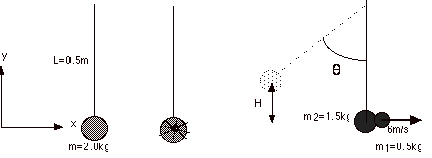
a. Calculate the linear
momentum, p2, of the second piece of the bob (m2) just after the explosion and write it in vector notation.
b. Calculate the speed, v2, and kinetic energy, K2, of the m2 piece just after the explosion.
c. Calculate the height, H, of the second piece when it stops (momentarily) and find the angle, q, the string makes with the vertical at that point.
5. A
block of mass 7.0 kg is traveling in the positive x direction on a frictionless
surface with a speed of 8.0m/s. At point A, the block encounters a rough patch
of 3.0m in length with a kinetic coefficient of friction of 0.25. At point B it
slides up a circular, frictionless ramp with a radius of 1.0m.
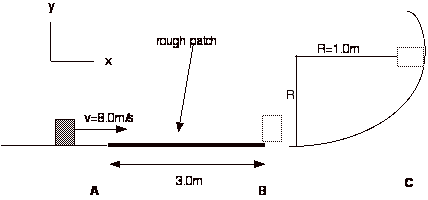
a. Calculate
the kinetic, potential and total energy of the system for the block at point A (take y=0 at ground level and ignore the height
of the block).
b. Calculate the
energy lost to friction between points A and B.
c. Calculate
the velocity of the block at point B.
d. Using
conservation of energy, find the velocity when the block is at a height of 1.0m
(at point C as shown above).
e. Find
the normal force that the ramp exerts on the block at this point.
PHY203
Exam
#3, F/01
Crib
Sheet
Chapters
6-8
(Note: Use 9.81 m/s2 for g, the acceleration due to gravity.)
(Note: Bold letters indicate vectors below.)
F
= ma
spring force: F = -kDx ,
where k is the spring constant
weight: W = mg
friction force:
kinetic fk = mkFn ,
where Fn is the normal force and mk is the
kinetic frictional coefficient
static fs < msFn,
fsmax = msFn
uniform circular motion
centripetal force: F = mv2/r
centripetal acceleration: a = v2/r
momentum
p = mv
Conservation of momentum: pinitial = pfinal
Work and Energy
W = F
. x = Fxcosq
Work done by friction = fkDs
Kinetic Energy: K = 1/2mv2
Potential Energy: Uspring = 1/2kx2
Ugrav
= mgh
Your Name: _______________________ PHY203
Final
Exam
Student ID: ________________________ Chapters
1-14
Thurs.,
12/13/01
Lecture Time: 9
a.m 1p.m. 2p.m. 3p.m. Honors
1 _________________ 7 __________________
2 _________________ 8 __________________
Part
1 ____________ Part
4 __________
3 _________________ 9 __________________
4 _________________ 10 __________________
Part
2 ____________ Part
5 ____________
5 _________________
6 _________________ Total
_______________
Part
3 ____________
9. A
block of unknown material weighs 5N in air and 4.55N when completely submerged
in water.
a. Calculate
the buoyant force.
b. Calculate
the density of the unknown material (use rwater = 1x10³
kg/m3).
10. A
block oscillates with an amplitude of A=5.8 cm attached to a horizontal spring
of force constant k=1.8 kN/m. Its
maximum speed is vmax=2.20 m/s.
a. Calculate
the angular frequency, w, of the motion of the block.
b. Calculate
the period, T, of the motion of the block.
c. Calculate
the mass, m, of the block.
PHY203
Final
Crib
Sheet, P. 1
speedAV
= (total distance traveled)/Dt
vAV = Dx/Dt
aAV = Dv/Dt
vInst = dx/dt
aInst = dv/dt
For constant acceleration:
xf = xo
+ vot + (1/2)at2
vf = vo
+ at
vf2 =
vo2 + 2a(xf - xo)
For a vector A with magnitude A and direction q
(measured counterclockwise with respect to the x-axis):
Ax = Acos(q)
Ay = Asin(q)
A = (Ax2 + Ay2)1/2
tan(q) = Ay/Ax
For a vectors A,B,C with magnitudes A,B,C:
If C
= A x B; C = ABsinq with direction of C given
by the right hand rule
(Note: Use 9.81 m/s2 for g, the acceleration due to gravity.)
spring force: F = -kDx ,
where k is the spring constant
momentum
p = mv
Conservation of momentum: pinitial = pfinal
torque: t
= r x F
angular momentum: L = r
x p =
Iw
parallel axis theorem: I
= ICM + Mh2
I solid sphere = 2/5MR2
Oscillations:
If x = Acos(wt + d); then v = -w Acos(wt + d)
for a spring, w =(k/m)1/2