Your Name: _______________________ PHY203
Exam
#2
Student ID: ________________________ Chapters
4-7
Thurs.,
10/23/03
Lecture Time: 9
a.m 1p.m. 2p.m. 3p.m. Honors
Score = 4 x (25 - ______)
|
|
1 |
2 |
3 |
4 |
5 |
6 |
7 |
8 |
9 |
10 |
11 |
12 |
13 |
14 |
15 |
16 |
17 |
18 |
19 |
20 |
21 |
22 |
23 |
24 |
25 |
|
a |
o |
o |
o |
o |
o |
o |
o |
o |
o |
o |
o |
o |
o |
o |
o |
o |
o |
o |
o |
o |
o |
o |
o |
o |
o |
|
b |
o |
o |
o |
o |
o |
o |
o |
o |
o |
o |
o |
o |
o |
o |
o |
o |
o |
o |
o |
o |
o |
o |
o |
o |
o |
|
c |
o |
o |
o |
o |
o |
o |
o |
o |
o |
o |
o |
o |
o |
o |
o |
o |
o |
o |
o |
o |
o |
o |
o |
o |
o |
|
d |
o |
o |
o |
o |
o |
o |
o |
o |
o |
o |
o |
o |
o |
o |
o |
o |
o |
o |
o |
o |
o |
o |
o |
o |
o |
|
e |
o |
o |
o |
o |
o |
o |
o |
o |
o |
o |
o |
o |
o |
o |
o |
o |
o |
o |
o |
o |
o |
o |
o |
o |
o |
Your Name: _______________________ PHY203
Exam
#2
Student ID: ________________________ Chapters
4-7
Thurs.,
10/23/03
1. A
block is pulled along a frictionless surface with a horizontal force of 10N.
The acceleration of the block is 2.5 m/s2. Calculate the mass of the
block:
a. 4.0
kg
b. 0.25
kg
c. 0.40
kg
d. 25.0
kg
e. 40.0
kg
2. A
block is pulled along on a frictionless surface with a horizontal pulling force
of 10N for a distance of 2m.
Calculate the work done:
a. 20
J
b. 5 J
c. 50
J
d. 2
J
e. 200
J
3. A
block is pulled horizontally along on a frictionless surface with a pulling
force of 10N at an angle of 60 degrees with respect to the horizontal for a
distance of 2m. Calculate the work
done:
a. 5J
b. 10 J
c. 20
J
d. 40
J
e. 2.5
J
4. A
particle of m=2 kg undergoes a displacement of d = -3mi + 6 mj. During
the displacement, a constant force, F = 5Ni + 10Nj, acts on the particle. Calculate the work done
by the force:
a. 0
J
b. 45 J
c. 75
J
d. -45
J
e. -75
J
5. A
block is pulled along on a frictionless surface for 2 minutes causing an
expenditure of 60J. Calculate the
average power during this time:
a. 0.50
W
b. 30 W
c. 60
W
d. 120
W
e. 7200
W
6. A
5 kg block is traveling along on a frictionless surface with an initial
velocity of 10 m/s. 50J of work is applied to the block. Calculate the final
velocity:
a. 4.5
m/s
b. 8.9
m/s
c. 10.5
m/s
d. 11.0
m/s
e. 12.3
m/s
7. A
block of mass 5 kg is attached to a spring and sitting on a horizontal
frictionless surface. With a spring extension of 20 cm, the energy stored in
the spring is 40J. Calculate the
spring constant of the spring:
a. 0.2
N/m
b. 2.0
N/m
c. 20
N/m
d. 200
N/m
e. 2000
N/m
8. A
block of mass 2 kg is accelerated from 10 m/s initial velocity by a pulling
force on a horizontal frictionless surface. After 2m the velocity of the block
is 15 m/s. Calculate the magnitude of the force:
a. 31.3
N
b. 62.5
N
c. 112.5
N
d. 125
N
e. 250
N
(For problems 9-12)
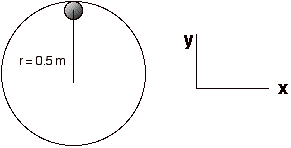
A sphere of mass, m=
2 kg, attached to a string is turning in a vertical circle with radius, r = 0.5 m. At the top of the
circle, the particle has a kinetic energy of K = 50J.
9. Calculate
the speed of the sphere at the top of the circle:
a. 5.0
m/s
b. 7.1
m/s
c. 10.0
m/s
d. 14.1
m/s
e. 25.0
m/s
10. Calculate the
tension, T, in the string at the top of the circle:
a. 80.4
N
b. 119.6
N
c. 180.4
N
d. 200.0
N
e. 220.0
N
11. Calculate
the potential energy of the sphere at the top of the circle, taking the origin
of the potential
energy as the center of the circle:
a. 0
J
b. 4.9 J
c. 9.8
J
d. 19.6
J
e. 39.2
J
12. Calculate
the kinetic energy of the sphere at the bottom of the circle:
a. 30.4
J
b. 40.2
J
c. 59.8
J
d. 69.6
J
e. 89.2
J
(For problems 13-14)
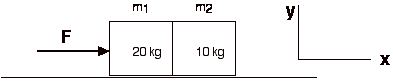
Two blocks, (m1 =20 kg and m2 =10kg) are pushed with a horizontal external
applied force,
F = 100N, as shown below.
Assume a frictionless
surface.
13. Calculate
the (same) acceleration of the blocks:
a. 0
m/s2
b. 3.33
m/s2
c. 5.0
m/s2
d. 6.67
m/s2
e. 10.0
m/s2
14. Calculate the magnitude of the contact force between the blocks:
a. 5.0
N
b. 10.0
N
c. 33.3
N
d. 66.7
N
e. 100
N
(For problems 15-17)
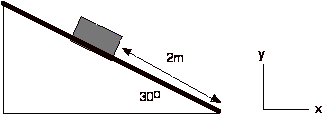
A block of mass 5.0
kg. is released on the ramp below and slides 2 meters down a 30o ramp.
15. Calculate
the potential energy of the block before it is released, taking the origin of
the potential
energy at the base of the ramp:
a. 24.5
J
b. 42.5
J
c. 49.0
J
d. 85.0
J
e. 98.0
J
16. Assuming
a frictionless ramp,
calculate the velocity of the block after it has traveled to the bottom of
the ramp:
a. 3.13
m/s
b. 4.12
m/s
c. 4.43
m/s
d. 5.83
m/s
e. 6.26
m/s
17. If
the ramp is in fact rough with a kinetic friction coefficient of mk = 0.25, calculate the energy converted
by friction to heat by the block sliding down the
ramp:
a. 10.6
J
b. 12.3
J
c. 21.2
J
d. 24.5
J
e. 42.2
J
(For problems 18-21)
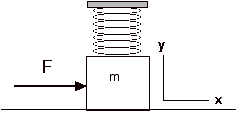
A block of mass m=5 kg is attached to a spring with spring constant, k = 200 N/m, and hangs down so that it rests on a table as shown below. This causes the spring to stretch by 10 cm from its equilibrium length. Assume the static coefficient of friction between the table and block is 0.6. An external force, F, is applied in the positive x-direction, as shown.
18. Calculate
the force on the block due to the stretched spring:
a. 2.0
N
b. 20.0
N
c. 69.0
N
d. 200
N
e. 2000
N
19. Calculate
the normal force on the block:
a. 9.0
N
b. 29.0
N
c. 49.0
N
d. 69.0
N
e. 89.0
N
20. What is the
direction of the static frictional force:
a. there
is none
b. +x
c. -x
d. +y
e. -y
21. Calculate maximum force, F, that can be
applied to the block such that the block will continue to remain at rest:
a. 5.4
N
b. 17.4
N
c. 29.4
N
d. 41.4
N
e. 53.4
N
(For problems 22-25)
A person with mass M = 50 kg is standing on a scale in an elevator.
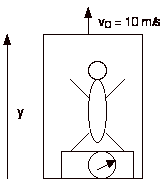
22. If the elevator is not moving, calculate the scale reading:
a. 0
N
b. 50 N
c. 240
N
d. 490
N
e. 740
N
23.
If the elevator is traveling upward with a constant velocity of 10 m/s,
calculate the scale reading:
a. 0
N
b. 9.5 N
c. 240
N
d. 490
N
e. 990
N
24.
If the elevator is accelerating upward with an acceleration of 10 m/s2,
calculate the scale reading:
a. 0
N
b. 9.5 N
c. 240
N
d. 490
N
e. 990
N
25.
If the elevator is traveling upward with an initial velocity of 10 m/s,
but is slowing down at a rate of
2 m/s2, calculate the scale reading:
a. 9.5
N
b. 390 N
c. 490
N
d. 590
N
e. 990
N
PHY203
Exam
#2, F/03
Crib
Sheet
Chapters 4-7
(Note: Use 9.81 m/s2 for g, the acceleration due to gravity.)
For constant acceleration(in one
dimension):
xf = xo
+ vot + (1/2)at2
vf = vo
+ at
vf2 =
vo2 + 2a(xf - xo)
(Note: Bold letters indicate vectors below.)
F
= ma
spring force: F = -kDx ,
where k is the spring constant
weight: W = mg
friction force:
kinetic fk = mkFn ,
where Fn is the normal force and mk is
the
kinetic frictional coefficient
static fs < msFn,
fsmax = msFn
uniform circular motion
centripetal acceleration: a = v2/R
Work and Energy
W = F
. d = Fdcosq
Work done by friction = -fkDs
EThermal =
|Work done by friction|
Kinetic Energy: K = (1/2)mv2
Potential Energy: Uspring = (1/2)kx2
Ugrav
= mgh
Total energy, E, is conserved ( a constant).
Power = Work/Time