Your Name: _______________________ PHY203
Exam
#2
Student ID: ________________________ Chapters
4-7
Thurs.,
10/24/02
Lecture Time: 9
a.m 1p.m. 2p.m. 3p.m. Honors
Score:
1 _________________ (out
of 17)
2 _________________ (out
of 17)
3 _________________ (out
of 33)
4 _________________ (out
of 33)
Total _______________
1. A
particle of m=2 kg undergoes a displacement of d = -3mi + 6 mj. During
the displacement, a constant force, F = 5Ni + 10Nj, acts on the particle. .
a. Calculate
the work done by the force in J.
b. Calculate
the final velocity of the particle in m/s assuming it started with an initial
velocity of 10 m/s before the force was applied.
2. A
sphere of mass, m= 2 kg, attached to a string is turning in a vertical
circle with radius, r = 0.5
m. At the top of the circle, the particle has a kinetic energy
of K = 50J.
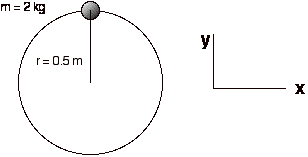
a. Sketch the forces on the particle
on the diagram above.
b.
Calculate the tension, T, in the string
in N at the top of the circle..
3.
Two blocks, (m1 =20 kg and m2
=10kg) are pushed with a horizontal external applied force, F, of magnitude 100N as shown below. Let Fc be the contact force between the two blocks. Assume a frictionless surface.
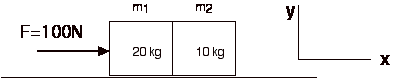
a.
Redraw the blocks and sketch all of the forces on each block (free body
diagrams).
b.
Write Newton’s 2nd law (force equation) in both axes
for both masses.
c.
Calculate the magnitude of the normal force on each block.
d. Calculate the magnitude of the contact force, Fc and the (same) acceleration, a, of the two blocks.
4. A
block of mass 5.0 kg. is released on the ramp below at point A and slides 2
meters down a rough 30o ramp which has a kinetic friction coefficient of mk = 0.25. The block travels over a frictionless surface between points B and C and then
encounters a spring with spring constant, k=8000 N/m.
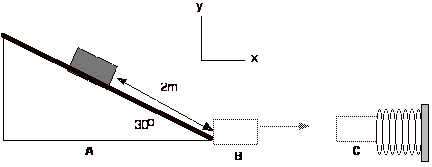
a. Calculate
the energy converted by friction to heat by the block sliding down the ramp.
b. Calculate the
kinetic energy point B once it has reached the bottom of the ramp.
c. Calculate
the distance by which the spring is compressed to bring the block to rest.
PHY203
Exam
#2, F/02
Crib
Sheet
Chapters 4-7
(Note: Use 9.81 m/s2 for g, the acceleration due to gravity.)
For constant acceleration(in one
dimension):
xf = xo
+ vot + (1/2)at2
vf = vo
+ at
vf2 =
vo2 + 2a(xf - xo)
(Note: Bold letters indicate vectors below.)
F
= ma
spring force: F = -kDx ,
where k is the spring constant
weight: W = mg
friction force:
kinetic fk = mkFn ,
where Fn is the normal force and mk is the
kinetic frictional coefficient
static fs < msFn,
fsmax = msFn
uniform circular motion
centripetal acceleration: a = v2/R
Work and Energy
W = F
. d = Fdcosq
Work done by friction = -fkDs
EThermal =
|Work done by friction|
Kinetic Energy: K = (1/2)mv2
Potential Energy: Uspring = (1/2)kx2
Ugrav
= mgh
Total energy, E, is conserved ( a constant).