Your Name: _______________________ PHY203
Exam
#1
Student ID: ________________________ Chapters
1-3
Thurs.,2/8/01
Lecture Section: 1 2
1.
Assume a plane flies in three legs:
Leg
A: 1.5 km due North
Leg
B: 2.5 km due West
Leg
C: 4 km at 60o South of East
a.
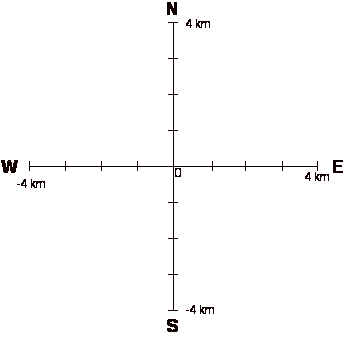
Sketch the vectors associated with the 3 legs on the following graph:
b.
Write down the vector notation (i,j) for the 3 legs with E as +x
direction and N as +y direction.
c.
Find the resultant displacement vector for the journey in vector
notation.
d.
Calculate the magnitude of the resultant displacement vector.
e.
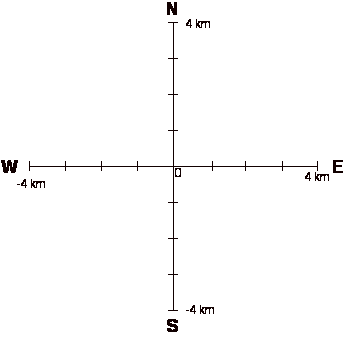
Sketch the resultant displacement vector on the graph below.
2.
For the displacement curve of a car on a 1D track, plot the
corresponding curves for velocity, a., and acceleration, b., (the displacement,
x, is in straight line segments except for the curve A-B, which is a
parabola). Be sure and add appropriate
coordinates to the vertical axes of the velocity and acceleration graphs.
c.
Calculate the average speed from points B-E.
d.
Calculate the average velocity from points B-E.
e.
Calculate the average acceleration from points B-F.
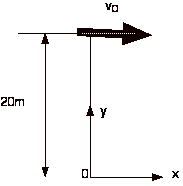
3. A missile is shot in a
horizontal direction from a cliff with height 20m and initial speed of 100m/s,
as shown. (Note: Use 9.81 m/s2 for the magnitude of g, the acceleration due to gravity.)
a.
Write the initial velocity vector, vo,
in vector notation.
b. Calculate the time in sec. that it will take for the missile
to hit the ground.
c.
Calculate the x position at which the missile will hit the ground.
d.
Calculate the final velocity, vf,
of the missile when it hits the ground (and present it in vector form).
PHY203
Exam
#1
Crib
Sheet
Chapters
1-3
speedAV
= (total distance traveled)/Dt
vAV = Dx/Dt
aAV = Dv/Dt
vInst = dx/dt
aInst = dv/dt
For constant acceleration:
xf = xo
+ vot + (1/2)at2
vf = vo
+ at
Vf2 =
vo2 + 2a(xf - xo)
(Note: Use 9.81 m/s2 for g, the acceleration due to gravity.)
For a vector A with magnitude A and direction q
(measured counterclockwise with respect to the x-axis):
Ax = Acos(q)
Ay = Asin(q)
A = (Ax2 + Ay2)1/2
tan(q) = Ay/Ax
Your Name: _______________________ PHY203
Exam
#1
Student ID: ________________________ Chapters
1-3
Thurs.,2/8/01
Lecture Section: 1 2
1.
For parts a.-d., write the following in correct scientific notation:
a.
100 picometers
b.
.01 gigakilograms
c.
The sum of 2.5x10⁻³
+ 3.7x10⁻⁴
d.
The conversion of 25,000 cm2 to ft2
e.
Given the equation F = A v2/m,
with F a force with SI units kg.m2/s, and v a velocity with units m/s, and m a mass
with unit kg; find the SI units of the constant A.